Showing posts with label Lake Toba. Show all posts

Saturday, August 25, 2012

The Best of Lake Toba: Where To Stay, What To Eat, and How To Get There


Oh, fair Lake Toba.  Home of the Batak cowboys, sky-piercing rooftops, indolent afternoons on the lakeside, and jaw-dropping landscapes in every direction.  Dare I say you were my favorite place to pass the days in all of Sumatra?


Destination ranking notwithstanding, we sure found some lovely places to lay our heads and spend our hard-earned rupiah.


Due to a bummer of a first night in a questionable locale (don't listen to the local boys on the ferry from Parapat), we took the better part of our first full day in Tuk-Tuk looking for the perfect guesthouse for the remainder of our stay.  We found Hariara Guesthouse and all of our modest needs were instantly met.


Nine dollars a night for the upstairs apartment shown below. On the lake.  With hot water. Yes, that's the real price.


Don't come to Lake Toba expecting to sample local delights.  Backpacker fare is the norm. That said, there were some food highlights.

Daily breakfast at Orari Restaurant. (Also good for motorbike rental)


Homemade brown bread and scrambled eggs with cheese and guacamole was a perfect start to our days!


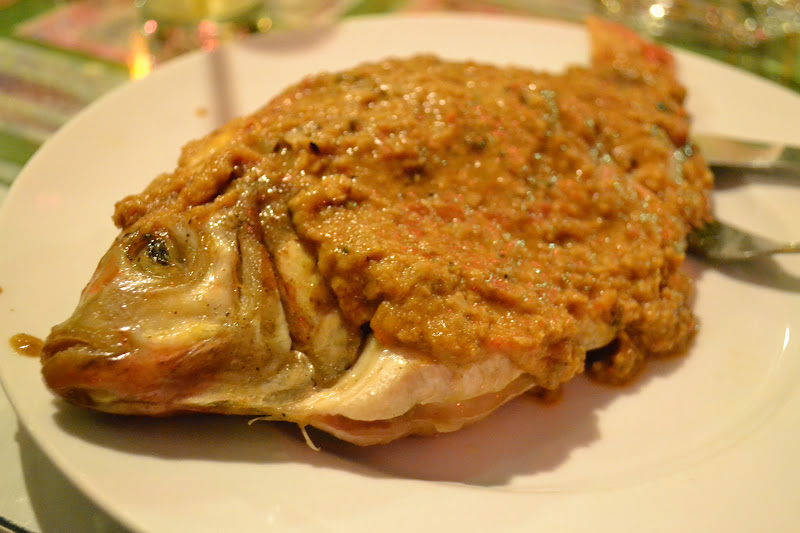
Dinner at Jenny's.  We loved everything about Jenny's: the food was great, the staff excessively welcoming, and the atmosphere continually lively with traditional Batak jams a couple times a week.  The best place to drink tuak (Batak palm wine) in Tuk-Tuk (go further into the hills surrounding the lake in the late afternoon to imbibe with local farmers).  Also, try their delectable fresh lake fish, grilled or barbequed.


Bamboo:  Great place for an afternoon coffee and a good read.  Steer clear of the overpriced and generally taste-less food.


How do you get to Lake Toba?  Since we were coming from Bukit Lawang, we took the "tourist bus" (a shared van) with a few other passengers.  Via Medan, we stopped mid-way in Berastagi, a sleepy town in the highlands where one can spend a couple days trekking up volcanoes and buying cabbage, but opted to continue on to the lake.  At 150,000 Rp. a person, the ride was reasonable and very comfortable.  While you can do the same trip for half the price, we were happy to splurge and avoid the chicken-bus boogie!


The Karo Highlands are the breadbasket of Sumatra, with fertile lands and cool, temperate weather.  The landscape reminded me of the American West, yet with active volcanoes rising from the coniferous forests.


The Karo Batak are a pious people and Protestant churches pepper the landscape on the way to the lake.


 After hurtling through the highlands, we finally reached Lake Toba!


We reached Parapat just in time to take the last ferry of the day over to Samosir Island and caught a beautiful sunset over the lake.


Practical Information:

Take a “Tourist Bus” (shared private car) to Lake Toba via Berastagi (Rp.150,000, includes ferry transport from Parapat to Tuk-Tuk, takes around seven hours).  Stayed at Hariara Bungalows (Rp. 90,000). Highly recommended with great location in Tuk-Tuk and nice waterfront rooms.  The upstairs apartment (room 1) is especially nice with a great balcony area. Eat the BBQ lake fish and drink Batak wine (tuak) at Jenny’s. Rent a motorbike(60,000 Rp) and drive from Tuk-Tuk along the lake to Ambarita for some Batak history and then onwards to the hot springs near Pangururan.  (Just be wary of crossing the island!)


Tuesday, August 21, 2012

Lake Toba: Motorbike Journey, Part 2

When we last left you on our harrowing tale, we had followed a road less traveled, which looked as if it had been hit with bombs, the black-top turned to gravel, riddled with deep blemishes and pot holes.  Our friends had (smartly) turned back, but Gavin and I had faith in our little manual bike, and pushed onwards to see the smallest lake on the largest island on the largest lake on the sixth largest island in the world (or something like that).  We had only a photocopy of a hand drawn map that had been give to us with the rental of the bikes to guide us on the journey.  We would later learn just how incorrect the map was, showing a direct route back to Tuk-Tuk from Lake Sidhoni that didn't really exist.

I guess I should also mention here that I made a detailed journal of our trip in its entirety.  I updated it almost daily.  This is an unedited exert directly taken from my journal of the events that transpired that day.


"June 19th - Having planned a bike trip with our friends the night before, the six of us met for breakfast, then got ready to head out.  Vicky and the Dutch woman, the Argentinians, and us.  Off we went, first stopping to take landscape photos, then at the stone seats, and a village of Batak houses.  Batak people are very interesting: Used to be cannibals until the 1800's, now mostly Christian, they are the minority in mostly Islamic Sumatra.  We rode on to Simanindo where there was a small and pointless museum.  Then to Parbaba where we thought a white sand beach was.  Well, pictures can be deceiving!  Dirty sand and shallow filthy water filled with teens jumping in fully-clothed.  All the girls and women stuck to the shore, covered in T-shirts and jeans despite the sunny day.  Not wanting to shock the locals, we stayed ashore while the guys went for a dip.  We ate lunch there, then continued on.  We had planned to stop in Buhil to see more weaving, but never a sign for it.  While our map made it look like Parbaba was quite far from Pangururan, it only took a few minutes to get there - this should have been out first sign that our map was faulty, but we continued on, trusting it as our guide.  After several wrong turns, we made it to the hot springs and took dips in the swimming pools filled with hot, spring water.  Our plan from there was to head inland to the largest lake on the island.  Samosir is famous for being something like the largest island on the world's largest crater lake (Toba).  So we it was intriguing to find another lake on that island!  Our map showed a road from the lake going straight back overland to Tuk-Tuk (where we were staying).  Although we had heard the roads were bad, just how bad could they be?  Well, within a few km inland the road got so bad that one of the bikes didn't even attempt the feat.  The other bikes' passenger hopped off due to the bumps.  After our trip through Vietnam's Central Highlands last year, we thought that we could handle the roads* and went on without our team, telling them we would meet back in Tuk-Tuk this evening."

*Might I add here that Gavin has an inability to "Double-Back," so, although I was fine with going back the way we came, it wasn't an option for him.


"The road was smooth again and we sped up to the "mighty" lake and had a look.  Here I mentioned filling up the tank of gas, but Gavin, being as cheap as ever, said he could make it on the half tank we had.**  We set off, but the road wasn't as it looked on the map, and every time we saw people, they pointed us in the supposedly right direction and we continued on."

**The full tank had come free with bike rental.


"As our gas continued to get lower, the sky started to darken as rain clouds moved in.  The roads continued to be awful, sometimes jerking us violently from side-to-side as we went.  We finally stopped for petrol, only to find out they were out, and there wasn't any more for miles.  We were pointed onwards, learning we were not on the road we thought we were on, and that road may not have in fact even existed.  We continued on as apparently other tourists had earlier taken this road.  As the sky darkened menacingly due to the late hour and the impending rain, we felt the first gentle rain drops slip from the sky.  About 30 minutes into this drive, we had yet to see a single person or house and appeared to be in uncharted territory on our map simply marked "Forest."  This is when I started to cry. 

Why were we out here?  Mostly because of Gavin's inability to "Double-Back" and due to our sheer stupidity.  We didn't have rain coats, a pocket knife, a lighter or even a flash light.  As it grew colder, our shirts and shorts over wet swimsuits were obviously not enough coverage.  Just when I was about to lose it, we rounded a bend to see three young men about our age, who we recognized from the hot springs earlier in the day, in worse shape than us.  They were helmet-less and somehow wearing less than us.  One had a flat tire, one's brakes were basically shot, and all were dangerously low on gas, plus they were driving automatics, not nearly as fit as our light, springy manual motorbike on the rough terrain.  They were at a fork in the road, wondering where to go and after a brief exchange of pleasantries, we all started off together.  There is power in numbers, right?"


"At this point, our bike kept sputtering out, losing our momentum, and cutting out due to a combination of low gas and rough terrain.  The sky opened up as we finally seemed to make it out of the forest and saw a tiny, ramshackle farmhouse.  We drove up and ran for cover from the rain.  Shivering and drenched, I realized these guys weren't going to be helpful at all.  I ran to the neighboring house and talked to the man and five children inside.  Petrol was down the road.  We had to move.  It was already 5:30 and the sun was not on our side and the rain was just continuing on.  It was here that we learned that only one of the four bikes had a light that worked - not ours - and looked around realizing there were no street lights to guide us once the sun set completely.  We drove on, stopping once more to check if we were going the right way.  When we did this, the others continued on without us - this is when we realized that it really is every man for himself! 

We carried on and sure enough we reached the end of the road and a petrol stand where the others were huddled under an overhang, trying to avoid the ice-cold, torrential downpour.  We filled up the tank and took a break.  The others seemed to want to stay, but I knew better.  Although the rain was worsening, I thought it might only be bad here, in the highlands of the interior of the island.  Plus the light was failing.  It was already 6:00 and the road we needed to take looked much smoother, so the 10km we were told we had to go didn't seem so bad.  We headed out, soaking wet, turning left from Parmanagan onto smooth road.  Gavin gunned it, weaving down the windy road as we shivered and thanked the heavens.  The others quickly fell behind us, probably moving much slower with their flat tires.  As I had predicted, the rain stopped within a few minutes.  Gavin stripped off his wet shirt because he was so cold and we could soon see Tuk-Tuk in the distance.  We kept going, speeding past other bikes, through the woods and villages, feeling exalted and hopeful now for future.  We arrived at the bike rental place just as it finally got dark.  Had we been just twenty minute longer, we would have had no light to navigate by.  We dropped off the bikes and went back to our apartment for a long, hot, delightful shower. "


Later that night, I would awake to a thundering rain storm, even harder and stronger than we had experienced earlier in the day.  It was the first rain Tuk-Tuk had seen in over a month and was the self-same storm we had encountered earlier that evening in the interior of the island. 

And that is how we almost froze to death in the Tropics...


Thursday, August 16, 2012

Lake Toba: A Motorbike Journey Around Samosir Island


With a group of our traveling pals we set off on a bright morning to tour Samosir Island by motorbike.


Our lovely Argentinian friends, Guido and Aylen.


A Scottish/Dutch combo on the third bike.


A map of the island our only guide.


After departing from Tuk-Tuk, our first stop was at Ambarita, a site of cultural significance for the Toba Batak people.


Ambarita was once the site of the king's residence and a court where important judicial meetings took place. On these self-same stone chairs, local elders met to decide the fate of transgressors.  Popular punishments included slashing the skin and placing salt and chili pepper in the wounds.  After a litany of other torturous methods were employed and death was inevitably met, the criminals were then boiled and consumed by the remaining members of the tribe.  Human flesh, especially certain parts of the body such as the earlobes and soles of the feet, were believed by the Toba Batak to contain vital nutrients and "soul-enhancers" (not the James Brown type).  Cannibalistic practices remained an important part of the culture up until the mid-19th century.


This tree, a victim of a recent storm, was butchered and later sent to the market.


A typical Sumatran school bus.


Water Buffalo.


The dusty, decrepit Huta Bolon Museum in Simanindo.  This is a traditional Batak village, located inside a small square that is surrounded by a tall bamboo fence.  Inside the huta, a row of long-houses faces to the mountains, where their communal God was thought to reside.


The borotan, or slaughter-pole, is placed directly in the center of the village and is adorned with carvings of animals and the leaves of the banyan tree (known as the tree of life).  During feasts or celebrations, a water-buffalo would be tied to this pole and subsequently... 


At a cafe across the street from the museum, a group of youngsters sat around playing guitar and crooning out solemn songs of unrequited love and hard times (peppered with the ubiquitous Bob Marley or Eagles classic).  Within contemporary Batak culture, the banalities of everyday existence are heightened by their cultural affinity for music (both Western and local).  It is rare to meet a young man or woman who cannot play guitar or sing a melody.  There is no better way to pass the time, and on this island, there surely is a lot of time to pass.


As the boys continued their communal chorus, the older patrons at the cafe chain-smoked, drank tea, and played chess.


"Welcome to Parbaba White Sand Beach". 


In one brochure, this strip of dirty sand and shallow, tepid water was referred to as "Toba's Little Slice of Bali". Located on the far northern shore of Samosir Island.  It wasn't quite Bali, but made for a nice pit-stop for lunch.


A youthful paradise on the shores of Lake Toba.


A local artist's not-so-subtle denouncing of logging and the devastating erosion created by the truck-monsters. 


We drove onwards to the fabled hot springs.


What were billed as natural hot springs turned out to be a restaurant/cafe and some man-made pools built into the side of the mountain.  However, geo-thermal activity was indeed present and some of us took a warm, muscle-soothing dip in the sulfurous water.


Stay away from narcotics.


Village life in the middle of the densely-forested island.  At this point the road was devastated and the rest of the group, smartly, turned back to return to Tuk-Tuk.


Attempting to find this tiny, unassuming pond was almost the end of us.  Deep in farm country, we braved treacherously unearthed roadways to encounter glorious Lake Sidhoni (a lake on an island on a lake on the world's sixth biggest island - confused yet?).


We did indeed park the bike and march down to the water's edge.  Encountering some proud ruminants...


...and a mischievous gang of raggamuffins fishing for froglets in a muddy stream.


Further afield, with the afternoon light declining, we took our last photo of the day before a rain-storm and the lack of a proper map left us cold, miserable, and hopeless.  Our last shot depicts another impressive ancestral tomb on the roadside before we set off into the wild...


TO BE CONTINUED...